

Imagine your newborn baby in a jerrican.
It sounds absurd, until you understand the brilliance behind it.
Vivian Arinaitwe, a 24-year-old biomedical engineer from Bushenyi, Western Uganda, is reimagining neonatal care for rural communities. Her journey began with her own birth. Her mother was carried on a sand truck to a primary birth attendant, where she born in her amniotic sac, and nearly left behind because no one knew what to do. Eventually, someone popped the sac.
“I reflect on my birth often,” she says. “It fuels my resolve to give babies a chance at life, no matter where they are born or how much money their parents have.”
Growing up, Vivian witnessed the harsh realities of rural healthcare. Mothers walked for hours to reach facilities without incubators or infant warmers. Babies died on the road. It was a story she heard often: “So-and-so’s baby turned blue,” or “So-and-so’s baby died on the road,” or “She gave birth on the road.” She considered becoming a doctor to help these mothers, but her fear of blood was grave. So, she chose biomedical engineering instead.
At Makerere University, she joined the Duke-Makerere Summer Biodesign Fellowship. The fellowship brings together students from Duke University and Makerere University into the same space, and then they go out into the community to identify problems, especially in healthcare.
Their visit to Kawempe Hospital’s maternity ward sparked the idea. A baby was born through a C-section. Those present in the room immediately knew they needed the Neonatal Intensive Care Unit (NICU). The baby needed to be in an incubator. They were on the third floor; the NICU was on the fifth. Vivian and her team ran alongside the nurse who was carrying the baby, now wrapped in a bedsheet.
“I remember asking my team, ‘Will this baby reach alive?’”
The NICU was full. There were more than two babies per infant warmer, more than two babies in each incubator. So they had to place this baby somewhere while they created space for it. The nurses, amused by the team’s shock and questions about the lack of sufficient incubators, explained that there are generally large numbers of babies born at the facility and the space is simply not enough.
“If you’re surprised by this and how we moved the baby, you should see how babies are transported from other hospitals,” they said, referring them to the ambulance personnel.
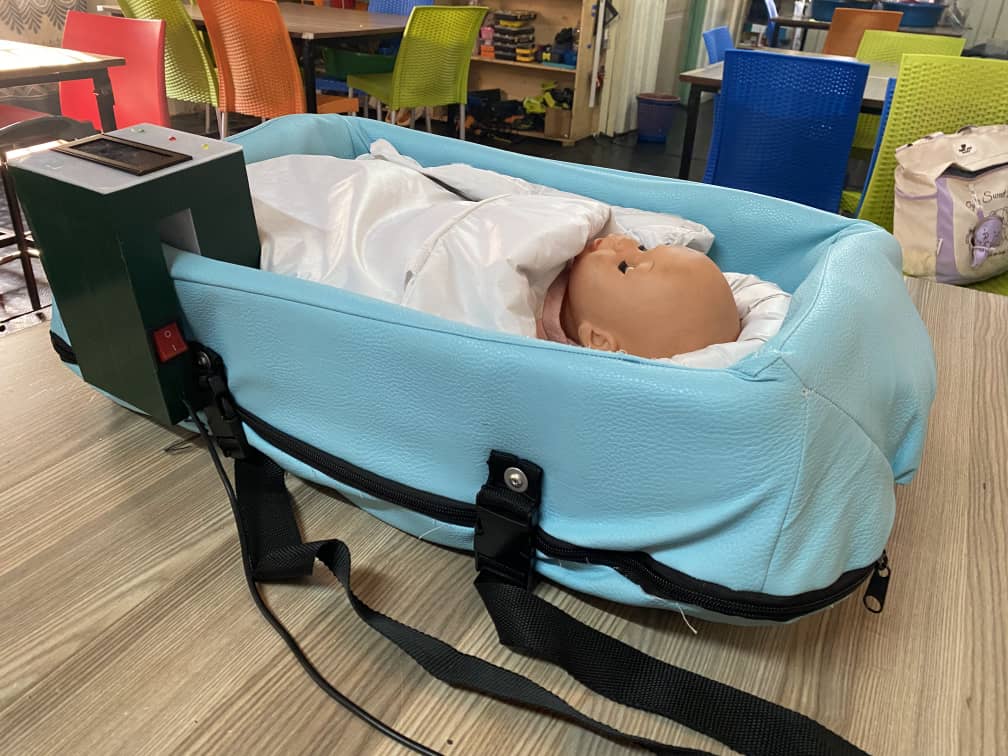
Transport incubators exist, but they are not designed for Uganda’s bumpy, dusty roads. Vivian and her team knew they needed a locally made, context-specific solution. They came up with NeoNest, a low-cost, locally built neonatal transport device designed to keep babies warm and safe. It maintains a temperature between 36.5°C and 37.5°C, treats hypothermia, and absorbs road shocks. It is made from jerrycans, wool-filled mattresses, and medical-grade materials like macintosh.
“We have added a nest feature that adjusts to the baby’s size and a hood to protect against wind, dust, and rain,” Vivian explains. “It’s designed for transport by boda boda, bicycle, or even walking.”
But designing a practical device is not enough, it will fail if the end user rejects it.
“Mothers said, ‘You’re putting my baby in a jerrican? No!’” Vivian recalls. “So, we redesigned it. Now, when they see it, they don’t see a jerrican. They see a life-saving device.”
Vivian’s team sought fresh perspectives from people who had never seen the device. They met a mother who had lost a baby during transport. Vivian calls her Rita. She had her baby in a rural Health Centre III in Rwampara District, South Western Uganda. The baby was preterm, so they had to transfer it to Mbarara Regional Referral Hospital, about 244 kilometres away. When they arrived, there were no available beds, so they had to go to another facility. The baby died on the way.
“This thing you are building, I wish it came sooner,” Rita told them.
NeoNest has undergone multiple iterations, each shaped by feedback from nurses, ambulance personnel, and mothers. They constantly check in with the staff at Kawempe hospital.
“Every time we made a change, we went back to them for feedback. The first time they saw the prototype, they said, “This can work!” The device was doing what it was intended to do. The next time they saw it, they asked, “Are you sure this will work?” They had doubts because the electronics had broken on the road, so when we met them, the device was not working as well as it should have. They also advised us that using one jerrican was too small and would only fit a preterm or very small baby, so we needed to make sure it could accommodate bigger babies. The last time they saw it, they asked, “When can we have this?”
t is easy to clean and includes monitoring systems to track the baby’s temperature and battery levels. It is low-cost. While existing transport incubators cost around USD 20,000 (about UGX 68 million), NeoNest is expected to cost no more than USD 300 (just over UGX 1 million).
“We get two twenty-litre jerricans and join them together to make a casing. We use materials like wool and mattress foam to assemble it. We make a comfortable bed for the baby that is also easy to clean. We have monitoring systems on it, so it can monitor the baby’s temperature, indicate when it’s too high or too low, and show if the device or battery is malfunctioning. It’s designed to be used by anyone—even those without medical training.”
They added a “nest” feature, a ring-like structure that adjusts to the baby’s size and absorbs road shocks. There is a hood to protect against wind, dust, and rain.
“We are specifically designing NeoNest for the transport that works for us. Many rural health centres do not have ambulances. They tell us they ask caregivers to carry the baby to the referral hospital because waiting for an ambulance can mean critical time wasted. We are looking at transporting this baby in the simplest of ways, safely and comfortably on a bicycle, boda boda on foot.”
The hardest part? Regulatory approval.
“We didn’t know the powers that be,” Vivian says. “We did things the old-school way, ethics committees, Ministry of Health approvals. It was tough, but we got our first regulatory clearance in just a year and a half.”
They learned that starting early with the regulatory team helps make the journey faster.
Vivian was named a finalist for the 2025 Africa Prize for Engineering Innovation.
“I screamed when I got the email,” she laughs. “My mom didn’t know what was happening, but I said, ‘Celebrate with me, you’ll understand later, and she did.”
Her success is inspiring others. One brother, who had dropped out of school, told her:
“I did not know there can be success after success. I am going back to school.”
He is now studying again.
Vivian is the co-founder of Che Innovations Uganda Limited alongside Joseph Okileng, Saajan Patel and Sophia Singer. Che is derived from ‘Che Che’ meaning spark in Swahili. Their mission is to bring medical prototypes off the shelf and into hospitals.
“Most devices in Uganda are donated or imported. They are not designed for us. That is why we have equipment graveyards in many facilities. We want to change that and NeoNest is just the beginning.”
The team envisions supporting 1,000 babies per month, reaching over 6,000 facilities across Uganda in two years’ time. They are hoping to work with the Ministry of Health to ensure these devices reach even the lowest-level health facilities.
“Uganda is building for Uganda. Africa is building for Africa. It’s a storm that will take the world by surprise.” “Vivian says. “Innovation, for me, is solving problems with the resources you have. It is making life easier, healthier, and better. And when it is frugal, like what we are doing with NeoNest, it is even more powerful. We want to bring local innovation to market and improve our own healthcare system.”
Hi, this is a comment.
To get started with moderating, editing, and deleting comments, please visit the Comments screen in the dashboard.
Commenter avatars come from Gravatar.